How Many Chickens Should a Beginner Start With? (Complete Guide)
So you have decided to raise backyard chickens — congratulations. Now comes the first real question every beginner faces: how many chickens should you actually start with?
Get the number wrong in either direction and you are in for headaches. Too few and your hens will be stressed and lonely (chickens are deeply social animals). Too many and you will be overwhelmed before you even figure out the basics of feeding, watering, and coop maintenance.
This guide gives you a clear answer based on your living situation, local laws, available space, and egg goals — plus breed recommendations that make a beginner’s first year as smooth as possible.
The Short Answer: Start With 3 to 6 Hens
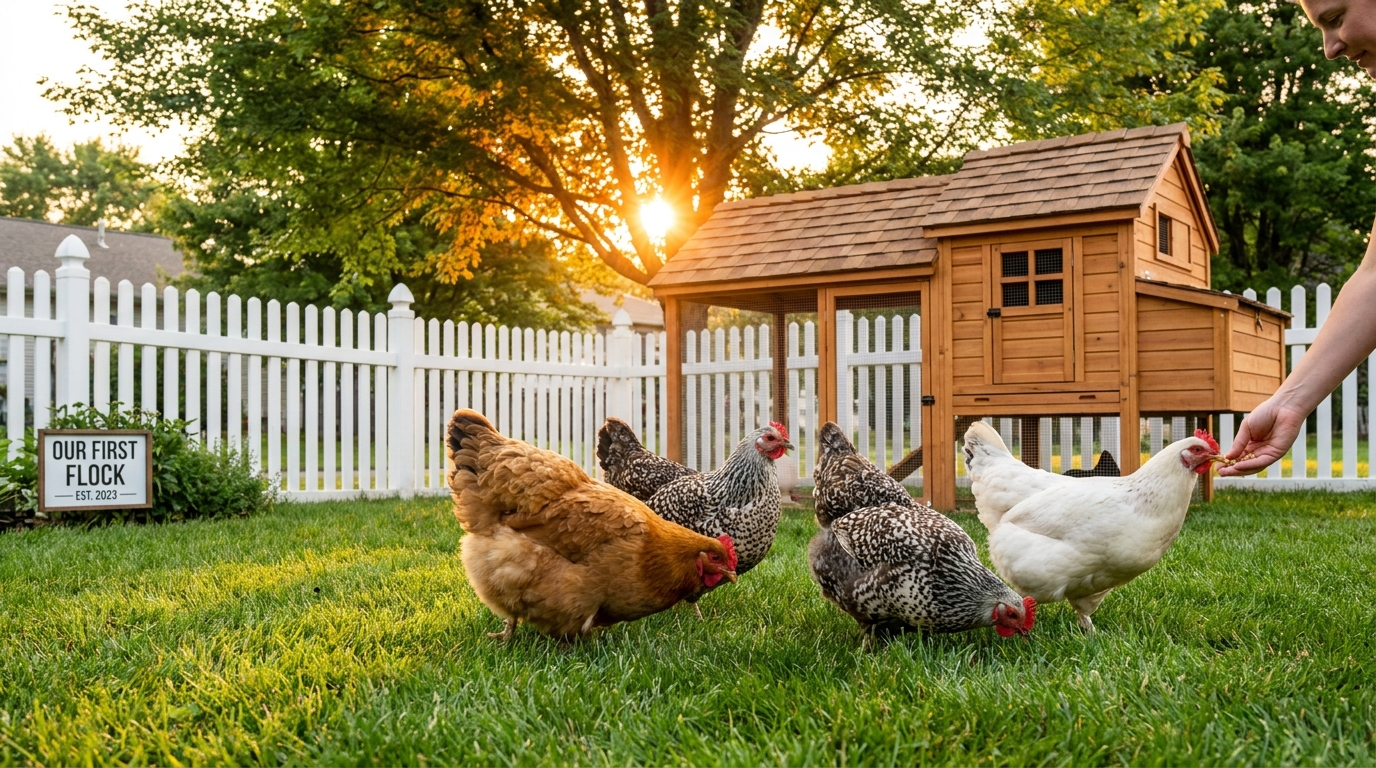
For most first-time chicken keepers, 3 to 6 hens is the ideal starting flock. Here is why that range works:
- Social needs met: Chickens are flock animals. A minimum of 3 hens ensures healthy social dynamics and reduces stress-related problems like feather picking.
- Manageable workload: Daily care for 3-6 hens takes about 10-15 minutes in the morning and 5-10 minutes in the evening. That is an easy routine to build.
- Steady egg supply: Even at the low end, 3 good layers will give you roughly 12-15 eggs per week — enough for a family of four with eggs to spare.
- Buffer for losses: If a hen gets sick or stops laying, you still have enough birds for a functional flock and a reliable egg supply.
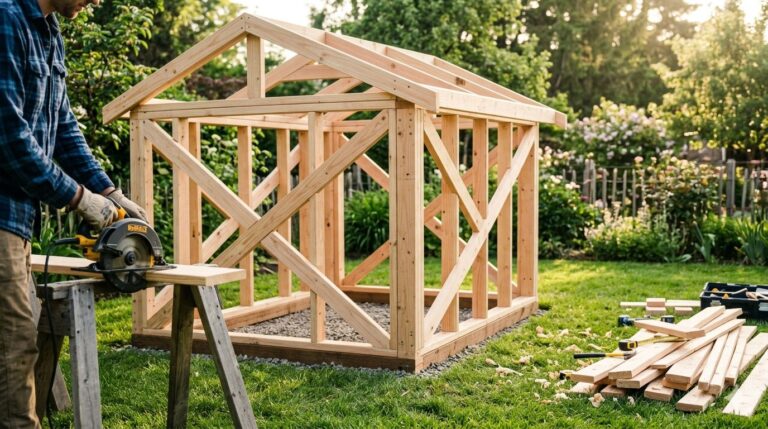
- Affordable to house: A coop for 3-6 hens is a straightforward weekend build. Check our 2026 coop cost breakdown for exact material prices.
Recommended Flock Size by Living Situation
Your property type and local regulations will shape exactly where you land within (or beyond) that 3-6 range:
| Living Situation | Recommended Flock Size | Why This Number |
|---|---|---|
| Suburban Lot (1/4 acre or less) | 3 – 4 hens | Most suburban ordinances cap flocks at 4-6 hens. Smaller flocks also reduce noise and odor concerns with neighbors. |
| Large Suburban / Small Rural (1/2 – 2 acres) | 4 – 8 hens | More space for a larger run. Great egg production for a family with extras to share or sell. |
| Rural Property / Homestead (2+ acres) | 8 – 15 hens | No space constraints. Enough eggs for your family plus neighbors, baking, and preserving. |
| Small Farm / Market Eggs | 15 – 30+ hens | If selling eggs at a farm stand or farmers market, 25-30 hens is the typical starting point for viability. |
The Egg Math: How Many Hens Do You Actually Need?
Before deciding on flock size, figure out how many eggs your household actually uses. Then work backward:
| Number of Hens | Eggs per Week (Avg) | Eggs per Month (Avg) | Best For |
|---|---|---|---|
| 3 hens | 12 – 15 | 50 – 65 | Single person or couple |
| 4 hens | 16 – 20 | 65 – 85 | Family of 3-4 |
| 6 hens | 24 – 30 | 100 – 130 | Family of 4-5, some to share |
| 8 hens | 32 – 40 | 130 – 170 | Large family, regular baking, gifting |
| 12 hens | 48 – 60 | 200 – 260 | Egg-heavy household, selling small amounts |
Keep in mind: These numbers assume healthy hens in their first or second year of laying. Production drops roughly 10-15% per year after that. Most hens produce 4-5 eggs per week during peak laying season (spring and summer) and slow down in winter when daylight hours decrease.
Space Requirements: The Non-Negotiable Numbers
No matter how many chickens you want, you need enough space to keep them healthy. Overcrowding leads to stress, aggression, disease, and reduced egg production. Here are the minimums:
| Space Type | Minimum per Bird | 4 Hens Need | 6 Hens Need | 8 Hens Need |
|---|---|---|---|---|
| Inside the Coop | 4 sq ft | 16 sq ft | 24 sq ft | 32 sq ft |
| Outdoor Run | 10 sq ft | 40 sq ft | 60 sq ft | 80 sq ft |
| Roosting Bar | 8–10 inches | 32–40 in | 48–60 in | 64–80 in |
| Nest Boxes | 1 per 3–4 hens | 1–2 boxes | 2 boxes | 2–3 boxes |
Important: These are minimums. More space is always better — hens with generous run space are healthier, calmer, and lay more consistently. If you can provide 15+ square feet of run space per bird, you will notice the difference in flock behavior.
Need help sizing your coop? Our coop plans bundle includes blueprints for 4-hen, 8-hen, and 20-hen coops with exact dimensions that meet or exceed these space requirements.
Check Your Local Laws First
Before you buy a single chick, check your local regulations. Many municipalities have specific rules about backyard poultry:
- Hen limits: Many suburban areas cap backyard flocks at 4-6 hens. Some allow up to 10-12 with a permit.
- Rooster bans: Most cities and suburbs prohibit roosters entirely due to noise. This is rarely a problem for egg production — hens lay eggs without a rooster.
- Setback requirements: Coops often must be a minimum distance (15-50 feet) from property lines and neighboring homes.
- Permit requirements: Some jurisdictions require a small animal permit or a coop inspection before you can keep chickens.
- HOA restrictions: If you live in a homeowners association, check the CC&Rs. Some HOAs prohibit poultry entirely, regardless of city ordinances.
Your city or county clerk’s office is the best starting point. Many municipalities also post their animal ordinances online — search for “[your city] backyard chicken ordinance” to find the current rules.
Best Beginner Chicken Breeds
Not all breeds are created equal for first-time keepers. The best beginner breeds are hardy, docile, consistent layers, and tolerant of a range of climates. Here are the top picks:
| Breed | Eggs per Year | Egg Color | Temperament | Cold Hardy |
|---|---|---|---|---|
| Rhode Island Red | 250 – 300 | Brown | Friendly, active | Yes |
| Plymouth Rock (Barred Rock) | 250 – 280 | Brown | Calm, docile | Yes |
| Australorp | 250 – 300 | Brown | Gentle, quiet | Yes |
| Buff Orpington | 200 – 280 | Brown | Very friendly, great with kids | Yes |
| ISA Brown (Hybrid) | 280 – 320 | Brown | Calm, easy to handle | Moderate |
| Sussex | 250 – 280 | Cream/Tan | Curious, friendly | Yes |
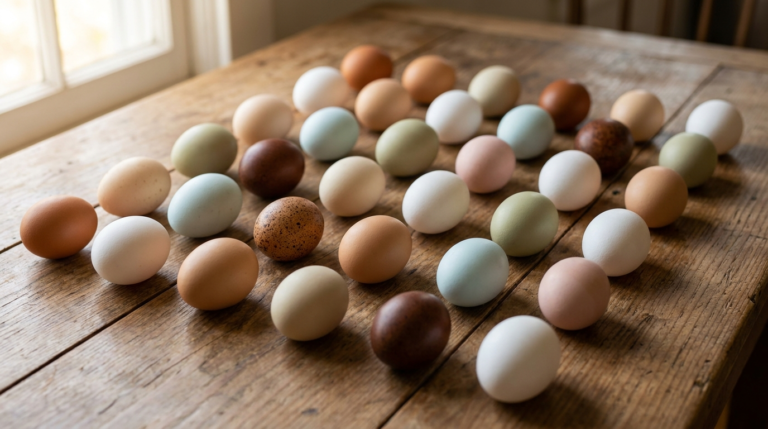
| Easter Egger | 200 – 280 | Blue/Green | Friendly, fun variety | Yes |
Beginner tip: Consider mixing 2-3 breeds in your starter flock. A mix of, say, 2 Rhode Island Reds, 2 Buff Orpingtons, and 2 Australorps gives you variety in egg color and personality while keeping things interesting. All three breeds are easygoing enough to coexist peacefully.
Common Beginner Mistakes With Flock Size
Starting With Just 1 or 2 Hens
A lone chicken is a stressed chicken. Hens are hardwired for flock life — isolation leads to anxiety, feather picking, and reduced laying. If you lose one hen from a pair, the remaining bird will struggle until you add companions. Always start with a minimum of 3.
Buying Too Many Too Fast
It is tempting to fill your coop to capacity on day one, but resist the urge. Start with 3-4 hens, learn the daily routine for a few months, and then add more if you want. Scaling up is easy. Downsizing a flock you cannot handle is stressful for both you and the birds.
Ignoring Space Limits
“Chicken math” is a real phenomenon — flock keepers joke about it because almost everyone ends up wanting more chickens than they planned for. Before you start, be honest about how much coop and run space you can realistically build. Overcrowding causes more problems than any other single mistake in backyard poultry.
Not Accounting for Winter
In cold climates, your hens will spend more time inside the coop. That means the indoor space requirement matters more than the run space for winter comfort. Make sure your coop is sized for full-time occupancy, not just nighttime roosting. Our predator-proofing guide also covers winterization tips.
Your Starter Flock Checklist
Here is a practical checklist to work through before bringing chickens home:
- Check local laws — confirm how many hens you can legally keep
- Calculate your egg needs — use the egg math table above to find your ideal flock size
- Measure your space — make sure you can provide 4 sq ft of coop + 10 sq ft of run per bird
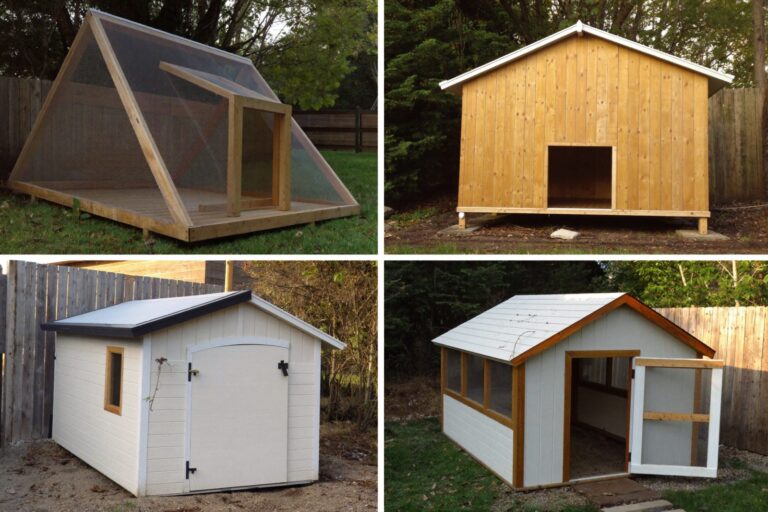
- Build or buy your coop — have it fully ready before the chicks arrive (see our coop plans)
- Choose your breeds — pick 2-3 beginner-friendly breeds from the table above
- Source your chicks — local farm stores, hatcheries, or breeders
- Set up a brooder — chicks need 4-6 weeks indoors under a heat lamp before moving to the coop
Ready to Build Your First Coop?
Once you know your flock size, you know your coop size. Our Complete Coop Plans Bundle ($27) includes detailed blueprints for small (4-hen), medium (8-hen), and large (20-hen) coops. Each plan comes with an exact materials list, cut list, and step-by-step instructions — so you can build a coop that is perfectly sized for your starter flock and ready to grow with you.
Frequently Asked Questions
Can I start with just 2 chickens?
While 2 chickens can technically survive together, it is not recommended. If one gets sick or dies, the remaining hen will be alone and stressed. Starting with 3 hens gives you a functional flock with a safety buffer, and the additional cost and effort is minimal.
How many chickens do I need to get a dozen eggs a week?
For a consistent dozen eggs per week, you need 3-4 good laying hens. Most productive breeds lay 4-5 eggs per week per hen. During winter or when hens are molting, production drops, so 4 hens gives you a better buffer than 3.
Is it better to start with chicks or adult hens?
Both work for beginners. Chicks cost less ($3-$5 each vs. $20-$35 for laying-age pullets) and bond with you from the start, but they require 4-6 weeks in a brooder and do not lay eggs until 18-24 weeks old. Adult pullets start laying immediately but cost more and may be less tame. Many beginners prefer started pullets (16-20 weeks old) as a middle ground.
Do I need a rooster for my hens to lay eggs?
No. Hens lay eggs with or without a rooster. A rooster is only needed if you want fertilized eggs for hatching. Since most suburban areas ban roosters due to noise, this is rarely an issue for backyard flocks.
How much does it cost to keep chickens per month?
For a small flock of 4-6 hens, expect to spend $20-$35 per month on feed (a 50 lb bag of layer feed costs $18-$28 and lasts about a month for 4-6 hens). Add $5-$10 for bedding (pine shavings) and occasional supplements. Total monthly cost: $25-$45. That works out to roughly $0.50-$1.00 per dozen eggs — far less than store-bought organic eggs at $5-$7 per dozen.